
Noise nuisance
Saturday afternoon in a hot and busy north London seemed like the ideal time for a quiet pint with a mate visiting London. We joined a mere handful of other customers in a pub – and a music system blasting out tunes whose volume and genre sat oddly with this clientele.
When we requested it be turned down so we could actually talk to each other, the guy behind the bar sheepishly apologised and said that there was nothing he could do as this was the music the landlord’s daughter wanted to listen to. When she appeared, we concluded she was a tad too scary to negotiate with, so we swiftly drank up and left.
This incident was quite a few years ago, so my current issues with noise in pubs – and increasingly restaurants – is not wholly down to an age thing. I’ve always liked to talk rather than shout at my friends when out eating and drinking with them. Music is certainly a major factor in noise levels rising in hospitality venues and is clearly a determinant of the clientele that places attract. But I’m not against music, it’s the volume that’s the issue in many venues.
We’ve also, undoubtedly, found ourselves in a situation where music/muzak plays a part in almost all out-of-home scenarios – it’s in doctor’s surgeries, dentists, shopping centres, lifts, taxis and so on. DJs used to be exclusively used on certain nights of the week but nowadays they seem ubiquitous. One even turned up at the opening of a bag of salad. I was at the media launch of a bagged salad range, and there on a plinth was a strutting DJ. He had been mentioned on the invite, so thankfully I was as prepared as the salads for the conversation-killing noise. I’ve also had poor night’s sleep in a number of smart hotels because the bass from the DJ in the bar was pulsating through the bones of the buildings.
However, it’s not just music, but also the gradual stripping out of fabric and textiles from hospitality venues that is adding to the cacophony. Some years ago – when I had some spare time on my hands – I walked the entire length of Brick Lane to see if any Indian restaurant had retained its carpet rather than following the trend for installing that horrendous cheap fake wood laminate flooring. I failed to find a single venue that had kept this bit of old school Brick Lane, which is also a great sound sponge.
JD Wetherspoon gets so much stick for its supposedly sticky carpets, but they play a major role in keeping its mega pubs conducive to conversation, even when full. The company has also just banned people from playing music or calls on their phone loudspeakers. Yet again, it’s Wetherspoon leading the way.
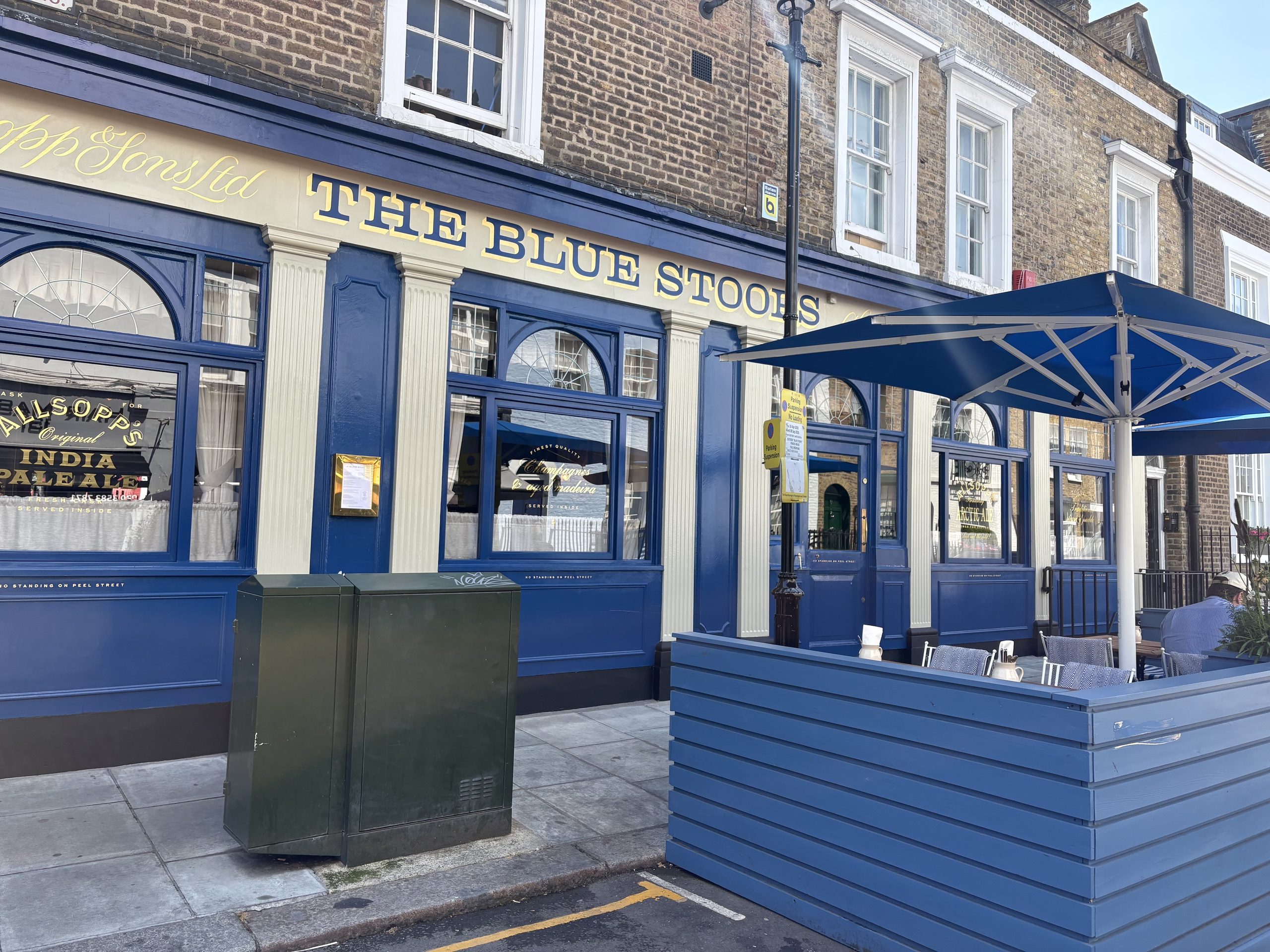
Charlie McVeigh, director of Allsopp’s Taverns, which runs The Blue Stoops in Notting Hill, also recognises that pubs are for conversation – but notes that carpet alone might not be enough. “When we opened, we put carpeting on the floor and had soft upholstery on the banquettes in the dining room, which we thought would be sufficient to stop the echoing roar of a crowded dining room,” he said. “We were wrong. It was a disaster. When the room was full, you could not hear yourself think, so we ended up applying a sound-absorbent material on to the ceiling, which has made all the difference.”
There is growing sensitivity to our ever-noisier surroundings – from all age groups. As many as 80% of people in the UK value quiet time, with 66% of 16 to 35-year-olds wanting a quieter home, according to a National Noise Report. In the US, 84% of people stated noise levels inform their purchasing decisions. I’m firmly in this camp and extend it to hospitality decisions.
I’d be naïve to think that age has not played a part in my own increased sensitivity to noisy venues and that of my associates. Many times now, ahead of meeting friends and family, they will request that I pick a quiet venue – whether this be a pub or restaurant. This has long been a concern when dealing with inter-generational get-togethers.
But this will become more of a pertinent point generally as the industry becomes more reliant on the older demographics. In the pub and bar sector, the share of spend by disengaged 18 to 34-year-olds is slipping, according to Reward, which also found that the 45 to 74-year-old grouping represents more frequent visitors and greater spenders.
Hospitality companies need to put much more thought into acoustics and the way music is handled because the alienation of any customers – particularly the noise-sensitive older grouping – is a serious mistake, especially when the solutions in many cases are relatively straightforward. Does a venue really need music, and what about the volume? And some soft furnishings could surely be used without necessarily turning a place into grandma’s parlour?
Glynn Davis, editor, Beer Insider
This piece was originally published on Propel Info where Glynn Davis writes a regular Friday opinion piece. Beer Insider would like to thank Propel for allowing the reproduction of this column.